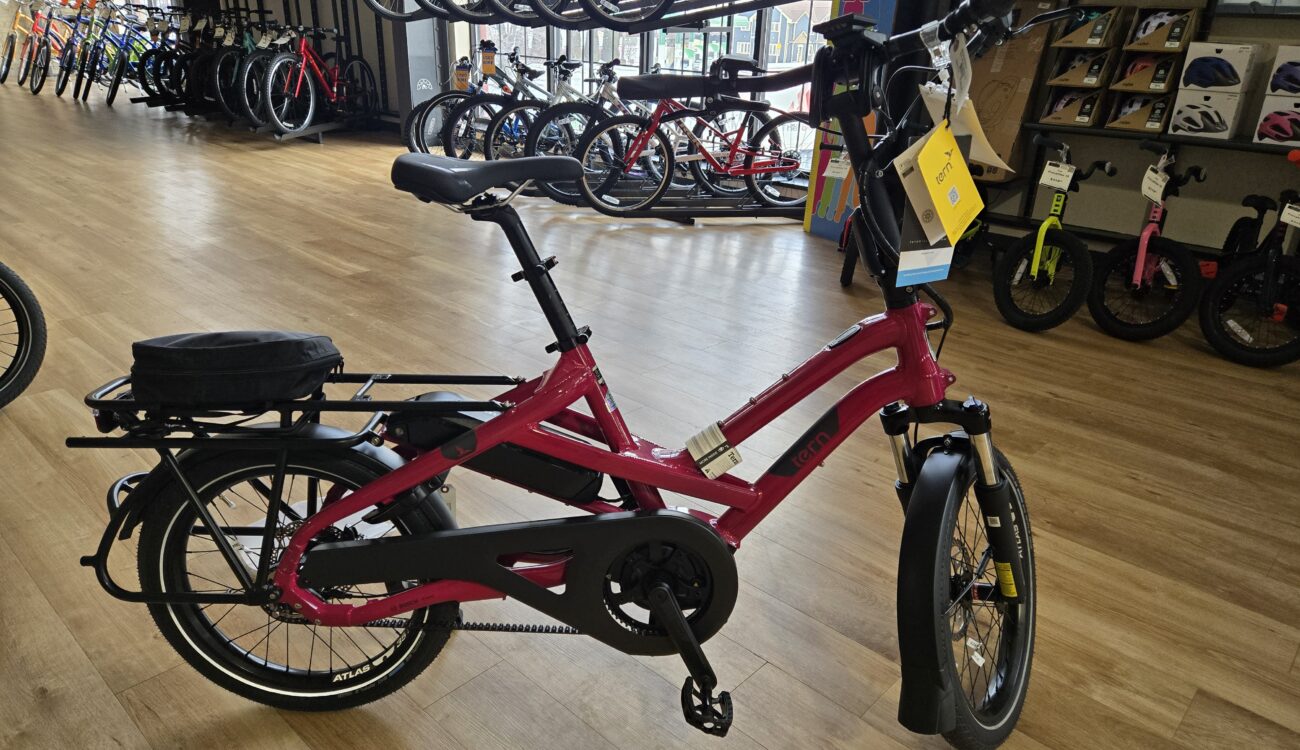
Electric bicycles (e-bikes) are transforming how people move, offering accessible, low-emission transportation and recreation. The Wisconsin Bike Fed and allied cycling advocates support clear, sensible e-bike policy that:
- Continues to recognize e-bikes as bicycles under the law
- Ensures safety and access for riders of all abilities
- Maintains sensible distinctions between low-speed e-bikes and more powerful motorized vehicles (like e-motos)
- Encourages responsible riding behavior and inclusive infrastructure
Legal E-bikes – Out of Class Electric Vehicles – Where can I ride E-bikes? – Safety & Etiquette – Maintenance & Travel – Legislative Recommendations – Resource Links
This resource aims to clarify what’s legal, where e-bikes can be ridden, safety and etiquette, maintenance basics, and current legislative priorities.
The following terms will be useful throughout the remainder of this page:
- E-bike: A bicycle equipped with an electric motor that provides assistance only when the rider is pedaling (or, in limited cases, via a low-speed throttle), and that meets specific speed and power limits so it is regulated as a bicycle
- E-moto or OCEV: A motor-driven electric two- or three-wheeled vehicle that may resemble a bicycle but does not meet the legal definition of an electric bicycle because it exceeds established limits for speed, power, or method of operation.
- Watts: Watts are a unit of power that describe how much work the motor can do at a given moment. For an e-bike, wattage indicates how strongly the motor can assist the rider—especially during acceleration, climbing hills, and carrying loads.
- Pedal Assist: A system in which an electric motor provides power only when the rider is actively pedaling. The motor amplifies the rider’s effort rather than replacing it, making riding easier while preserving the feel and function of a bicycle.
- Throttle: A control (typically a twist grip or thumb lever) that allows the electric motor to deliver power on demand, without the rider pedaling.
What Is a Legal E-Bike? (Wisconsin & U.S.)
Federal / Model Definition
Under federal product law, a “low-speed electric bicycle” is a vehicle with:
- Two or three wheels
- Fully operable pedals
- An electric motor ≤ 750 watts (750w = 1hp)
- A top motor-assisted speed under 20 mph (Class 1 and 2) — or up to 28 mph (Class 3) when assistance requires pedaling
This classification is used as the foundation for most U.S. state laws and advocacy frameworks.
Wisconsin Law — 2019 Act 34
In Wisconsin, the 2019 Wisconsin Act 34 legalized e-bikes statewide and created a three-class system that defines e-bikes and how they are regulated for riders and trail access:
Three Class System (Wisconsin):
- Class 1 — Electric pedal-assist only; motor assists up to 20 mph
- Class 2 — Throttle-assist (motor can propel without pedaling), up to 20 mph
- Class 3 — Pedal-assist only; motor assists up to 28 mph; speedometer required and operator must be 16 years of age or older
Under this law:
- Manufacturers must permanently affix labels indicating class, wattage, and speed
- E-bikes are treated like bicycles for most rights and duties
What Is an Illegal E-Bike? / OCEV / e-moto
Out-of-Class Electric Vehicle (OCEV)
Devices that:
- Exceed 750 watts
- Can go over 28 mph under motor assist
- Lack fully operable pedals
- Are designed to circumvent class limits
- Are not legal ebikes and may be considered motor vehicles (requiring registration, license, insurance) or prohibited on bike infrastructure
This category often includes e-motos — essentially off-road or motor-bike-like electric vehicles disguised as e-bikes. These devices pose legal and safety risks and are not covered under the three-class system.
Key illegal features:
- Motor power >750 W
- Top assisted speeds beyond class limits
- Modes that switch into high-speed “off-road” without pedaling
- Removing/detaching pedals entirely
- “Hacking” legal devices to operate illegally
Because federal law defines low-speed e-bikes only up to 20 mph (and state laws expand that to 28 mph for Class 3), anything outside that definition loses the protections and access rights provided by e-bike statutes.
Where Can You Ride an E-Bike?
General Riding Rights
In Wisconsin:
- E-bikes may be ridden wherever bicycles are allowed on roads and bike lanes; no license, registration, or insurance is required
- Sidewalk usage is subject to local ordinance, we will add to our list of sidewalk resources as they become available
- Class 3 e-bikes are restricted to operators 16 years and older
Trails & Shared Paths
Trail access is often governed by the agency that manages that land:
- State trails / parks (DNR): Many bicycle touring trails allow Class 1 and Class 3 with a 15 mph cap and no throttle on the trail (Class 2 often excluded)
- County Parks & City Trails: Local parks or paved trails may set their own rules as some parks limit ebike usage to Class 1
- Federally funded non-motorized trails: Permitted where local regulations allow (e.g., BLM or FWS lands with management discretion)
Jurisdictional oversight:
- Local Roads: City Government control and enforced by local Police Departments
- State Roads: Wisconsin DOT manages but generally under local jurisdiction.
- State trails/parks: Wisconsin DNR & local park boards
- Bike paths & local shared-use trails: Cities/counties can restrict power use under their ordinances, Enforcement by Sheriff Department or Park Rangers
Enforcement Challenge:
Because e-bikes can look like traditional bikes and OCEV/e-motos can also appear as legal e-bikes, making enforcement more difficult. Enforcement resources are limited, rules like trail speed limits and class restrictions are inconsistently enforced. Local signage and proactive education are critical.
Safety, Rules, & Etiquette
Rules of the Road
E-bikes follow the same traffic rules as traditional bicycles, including:
- Obey traffic signals
- Ride with traffic
- Signal turns
- Yield to pedestrians
Helmets are recommended (especially Class 3). Although helmets are not required statewide, some municipalities do require them. Check your local ordinances.
Trail / Path Etiquette
Responsible e-bikes riders should:
- Stay within posted speed limits
- Yield to walkers and traditional bike traffic
- Use audible signals when passing
- Slow down when near other trail users.
Safety Tips
- Practice braking and throttle control – braking takes longer from higher speed
- Understand battery discharge and range
- Be mindful of heavier weight and longer stopping distances on e-bikes
Maintenance & Travel
Battery & Storage
- Store batteries in a dry, temperature-controlled area
- Cold weather charging can damage the battery
- Ensure charged batteries are not near combustible materials
Travel & Racks
- Use racks rated for the weight of an ebike
- Remove batteries for travel when possible
Routine Checks
- Tire pressure and brake function
- Chain and drivetrain wear
- Motor operation and cables
- Battery condition
Buying from a local bike shop increases access to service and compatible parts. Not all bike shops will work on OCEV, or even legal e-bike brands they do not sell or carry insurance for.
Legislative Recommendations & Advocacy
What We Are Considering
Our advocacy platform includes:
- Protect the 3-Class framework – resist over-regulation that treats e-bikes like motor vehicles
- OCEV/e-moto legislation – clarify legal definitions, distinctions and regulations for out-of-class vehicles and retailers who sell them
- Battery safety standards & certification – support UL and safety pledges like the National Bicycle Dealers Association’s battery and product certification pledge
- Clear trail access policies – coordinate among DNR, local parks, and advocacy organizations
- Education and signage – on shared paths and throughout our community
Timeline of Actions
- Short Term: Educate riders and land managers; push for consistent signage and speed postings.
- Mid Term: Advocate for local ordinances that keep e-bikes on bike-appropriate infrastructure.
- Long Term: Encourage model policies that protect low-speed e-bike access while regulating out-of-class devices.
Calls to Action
- Ask your city/county boards to avoid blanket bans and align with state law to reduce cross-municipality changes in law
- Ask your city/county boards to adopt clear e-bike access policies that allow all classes of e-bikes on shared use paths
- Promote signage at trailheads or common spaces to post regulations and clarify where e-bikes are permitted
- Encourage state representatives to protect the 3-class system for e-bikes
Key Resource Links
Advocacy & Policy
- PeopleForBikes electric bike policies and laws
- League of American Bicyclists e-bike resources
- NBDA e-bike safety pledge and resources
Wisconsin Specific
Educational Media
PeopleForBikes: E-bike toolkit and legislative webinar
YouTube: Watts Up with e-bikes & alternatives in Wisconsin
Built For Safety E-bike episode
Related Content

DIY Economic Impact Program Helps 3 Vilas Area Groups Produce Reports
Three trail groups that roll through the Vilas County area have known… 1 Read more about DIY Economic Impact Program Helps 3 Vilas Area Groups Produce Reports
Bike Fed License Plate
Driving for Safe BicyclingRead more about Bike Fed License Plate
Turning the Pedals from 2025 to 2026
The past year has brought challenges to people who love to bike… 1 Read more about Turning the Pedals from 2025 to 2026